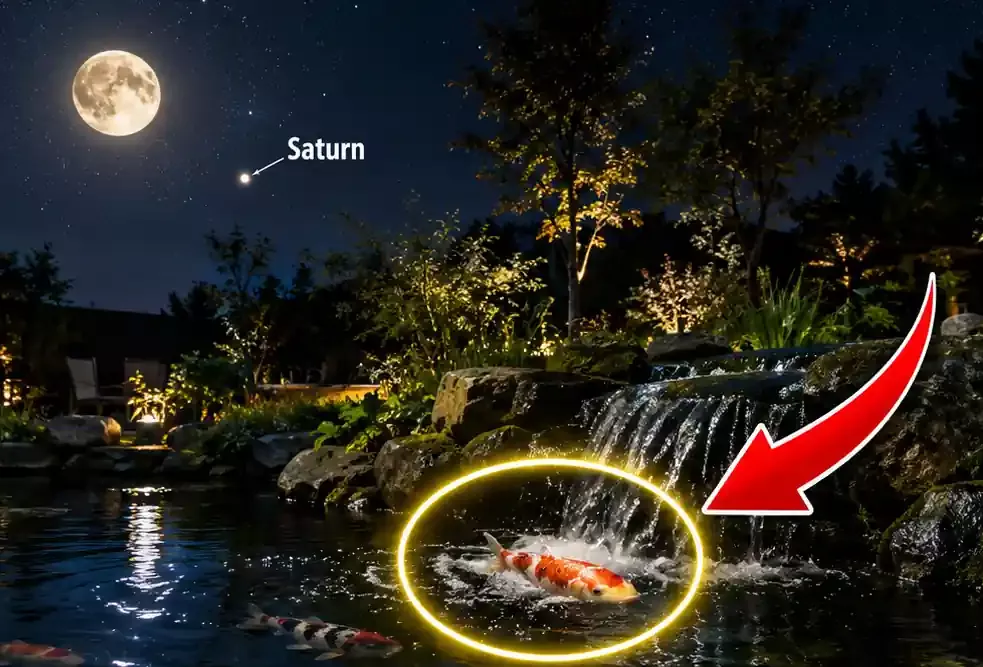
Tonight, skywatchers are looking up at the Moon and Saturn. But if you own koi, the real mystery might be happening below — in your pond.
There is something irresistible about a night-sky event. The Moon hangs there like a glowing signal. Saturn, the ringed planet, appears nearby like the universe casually showing off. People step outside, look up, point at the sky, and suddenly everyone becomes an amateur astronomer for ten minutes.
“Is that Saturn?”
“I think that’s Saturn.”
“No, that’s a plane.”
“Why is the plane not moving?”
“Okay, maybe it’s Saturn.”
While everyone is busy staring at the sky, your koi pond is doing something just as fascinating — and much more important to the fish that live in it.
Because a koi pond does not shut down at night.
It changes.
The oxygen changes. The fish behavior changes. The plants change what they are doing. Predators become more confident. Pond lights start affecting the environment. Pumps and waterfalls become even more important. And by early morning, a pond that looked peaceful under the moonlight can reveal whether everything is healthy — or whether your koi spent the night in a low-oxygen danger zone.
So yes, look up at the Moon and Saturn.
But then look down.
Your koi pond has a night shift, and it may be hiding more drama than the sky.
Your Koi Pond Does Not Sleep
At night, your backyard gets quiet. The patio empties. The birds stop yelling. The neighborhood lawn equipment finally gives humanity a break. The pond looks calm and mysterious, reflecting the moon, stars, landscape lights, and maybe the faint glow of your kitchen window.
It feels like the pond is asleep.
It is not.
Your koi may slow down, but the pond ecosystem is still working. Fish are still breathing. Bacteria are still processing waste. Plants and algae are still alive. Water is still moving through the filter. Predators are still roaming. Oxygen is still being used. Waste is still being broken down.
A koi pond at night is not a sleeping pond.
It is a pond running in dark mode.
And just like your phone in dark mode, it may look calmer, but a lot is still happening behind the screen.
The Big Nighttime Secret: Oxygen Can Drop While You Sleep
The most important thing koi owners need to understand about nighttime pond care is oxygen.
During the day, aquatic plants and algae can produce oxygen through photosynthesis when sunlight is available. That is helpful. But at night, photosynthesis stops. Plants and algae do not keep producing oxygen in the dark. Instead, they continue using oxygen through respiration, just like fish and bacteria do.
That means your pond can lose oxygen overnight.
This is especially important during summer, warm weather, algae blooms, heavy feeding, overstocking, or after a long cloudy stretch. Warm water holds less oxygen than cool water, and koi need oxygen to survive. Beneficial bacteria in the filter also need oxygen to process fish waste.
So while you are sleeping peacefully, your pond may be slowly drifting toward its lowest oxygen point of the day.
That is why koi often gasp early in the morning rather than in the middle of the afternoon. The pond can look beautiful at night and still be approaching an oxygen problem before sunrise.
Your koi do not care how magical the moon reflection looks if the water is running out of oxygen.
Why Gasping Koi Often Show Up at Sunrise
If you ever walk outside in the morning and see koi gathered at the surface, opening and closing their mouths, hanging near the waterfall, or crowding around air stones, pay attention.
That can be a warning sign.
Koi gasping near the surface may mean oxygen is low. Fish often gather near waterfalls, fountains, filter returns, or air diffusers because those areas usually contain more oxygen and surface agitation.
That is not your koi enjoying the “pond spa.”
That is your koi saying, “Excuse me, the oxygen situation in the rest of the pond is suspicious.”
Morning gasping can happen when:
- The pond is too warm
- The pond is overstocked
- There is too much algae
- An algae bloom died off
- The pump or waterfall slowed down overnight
- The air pump failed
- The filter is clogged
- There is too much decaying organic material
- The pond was heavily fed the day before
If several koi are gasping, treat it like an urgent warning. Add aeration, check pump flow, stop feeding temporarily, and test the water.
For more on pond testing, see: Koi Pond Water Quality Guide
Nighttime Aeration Is Not Decoration — It Is Life Support
A waterfall looks beautiful during the day. At night, it can become one of the most important features in the pond.
Moving water helps with gas exchange. Air pumps, diffusers, waterfalls, fountains, and streams all help keep oxygen moving through the system. During the overnight hours, when plants are no longer producing oxygen, aeration matters even more.
This is why turning off the waterfall at night can be a bad idea.
Some pond owners shut off waterfalls because they want quiet. Others do it to save electricity. Others think the pond does not need movement overnight because the fish are less active.
That logic sounds reasonable until you remember that the pond is still breathing.
Turning off aeration at night is like deciding your fish can hold their breath until morning because the waterfall noise is inconvenient.
Do not make your koi live through your sleep settings.
Before bed, check:
- Is the waterfall flowing normally?
- Is the air pump running?
- Are diffusers producing strong bubbles?
- Is the skimmer basket clogged?
- Is the water level high enough for proper pump operation?
- Is the filter flowing normally?
A quick nighttime check can prevent an ugly morning surprise.
Your Pond Lights Might Be Gorgeous… But Are They Too Much?
Pond lighting can make a koi pond look incredible at night. A few warm lights around rocks, waterfalls, plants, and pathways can turn a backyard into something that looks like it belongs at a resort where someone charges $19 for cucumber water.
But fish live in that environment. They are not just decorative objects under a spotlight.
Artificial light at night can affect fish behavior. Light can influence feeding, hiding, predator avoidance, movement, and stress. That does not mean all pond lights are bad. It means pond lighting should be thoughtful.
Your koi do not need to live under stadium lights.
If your pond is lit up like a car dealership at midnight, your fish may never get a proper dark period. Bright lights can also make fish more visible to predators. A raccoon does not need you to install buffet lighting, but it will certainly appreciate the service.
Better pond lighting habits:
- Use soft, indirect lighting instead of blasting light into the water.
- Avoid leaving intense underwater lights on all night.
- Use timers so the pond gets a dark period.
- Place lights for safety and aesthetics, not constant fish illumination.
- Avoid sudden bright lights directly over hiding areas.
- Consider warm, subtle lighting around the pond edge instead of harsh blue-white light.
The goal is nighttime beauty without turning your koi pond into a 24-hour interrogation room.
The Night Shift Predators Are Very Interested in Your Koi
During the day, your koi pond may feel safe. You are around. The yard is active. Dogs bark. People move around. Predators stay cautious.
At night, the pond becomes a different place.
Raccoons, herons, mink, owls, cats, snakes, and other wildlife may become more confident. Some predators are especially active around dawn and dusk. Those quiet hours can be dangerous because koi are less alert, visibility is lower, and the yard is calm.
A raccoon does not look at your koi pond and see “peaceful aquatic ecosystem.”
It sees sushi with landscaping.
Herons can also be a major threat, especially in shallow ponds or ponds without protective cover. Even if a predator does not catch a fish, it can injure koi, stress the pond, or cause fish to jump.
Nighttime predator protection ideas:
- Use pond netting when needed.
- Provide deeper areas where koi can retreat.
- Add plant cover and hiding places.
- Use motion-activated sprinklers or lights carefully.
- Keep pond edges difficult for predators to stand on.
- Avoid bright lights that make koi easy to spot all night.
- Check for tracks, disturbed rocks, or damaged plants in the morning.
A secure pond lets your koi survive the night without becoming the featured item on a raccoon tasting menu.
What Koi Actually Do at Night
Koi are not nocturnal party animals, but they do not simply shut off like pool lights either.
At night, koi often become less active. They may rest in deeper areas, gather in calmer sections, or move more slowly. Some will still cruise around, especially in warm water. Their behavior depends on water temperature, oxygen levels, predator pressure, lighting, pond design, and overall health.
Healthy nighttime koi behavior may include:
- Slow cruising
- Resting near the bottom
- Gathering in calm areas
- Reduced feeding interest
- Using plant cover or deeper water
Concerning nighttime or early-morning behavior includes:
- Gasping at the surface
- Jumping or splashing repeatedly
- Frantic swimming
- Clamped fins
- Fish crowding around oxygen sources
- One fish isolating or sitting unusually
- Fish flashing against surfaces
In other words, koi can rest at night. But they should not look like they are starring in a fish emergency documentary.
The Creepiest Time for a Pond Problem: Right Before Dawn
If a koi pond has an oxygen problem, the danger often peaks before sunrise.
That is when the pond may have gone all night without photosynthesis, while fish, plants, algae, and bacteria continued consuming oxygen. The pond may look still, dark, and peaceful, but oxygen levels can be at their lowest.
This is why the first check of the morning matters.
If your koi are active and relaxed, great.
If they are gasping, hanging at the surface, or gathered tightly near moving water, do not shrug it off. That is your pond sending an alert before breakfast.
Koi do not have an emergency siren.
They have behavior.
You have to read it.
Should You Feed Koi at Night?
Usually, it is better to feed koi during daylight or early evening when you can observe them clearly and remove uneaten food if needed.
Night feeding is not automatically forbidden, but it has downsides. You may not see how much they eat. Uneaten food can sink and decay. Predators may be more active. If oxygen is lower overnight, adding a big food load before dark increases the pond’s biological workload.
Koi are already professional food beggars. They do not need a midnight snack program.
Feed when you can watch them. Feed what they will eat quickly. Adjust feeding based on water temperature and water quality. If fish are acting off or oxygen is questionable, skip feeding.
Your koi may act personally betrayed, but they will survive.
Your water quality might not survive a late-night buffet.
The Backyard Astronomy Trick: Use Skywatching as a Pond Check
Tonight’s Moon-Saturn event is the perfect excuse to do something simple and useful.
When you step outside to look up, also look down.
Take one minute to check the pond.
Ask yourself:
- Is the waterfall running normally?
- Are the air bubbles strong?
- Are the koi calm?
- Are any fish gasping?
- Are predators or pets near the pond?
- Are pond lights too bright?
- Is the water level normal?
- Is the skimmer pulling properly?
This is the easiest pond-care habit in the world. Look at Saturn. Check the koi. Feel like a responsible backyard scientist.
You do not need a telescope. You need observation.
Nighttime Pond Checklist Before You Go Inside
Here is a quick routine that can help protect your koi overnight:
- Check pump flow: Make sure the waterfall, stream, and filter return look normal.
- Check aeration: Air stones or diffusers should be bubbling strongly.
- Look at fish behavior: Koi should not be gasping, flashing, or acting frantic.
- Check water level: Low water can reduce pump performance.
- Inspect skimmer basket: A clogged skimmer can reduce flow overnight.
- Secure pond netting: Especially if predators are common in your area.
- Adjust lighting: Avoid harsh lights shining into the pond all night.
- Skip late feeding: Do not add food right before the pond enters its overnight oxygen dip.
This routine takes less time than finding Saturn in the sky, and it may save your fish from a rough night.
What to Check First Thing in the Morning
The morning pond check is just as important as the night check.
Look for:
- Koi gasping at the surface
- Fish gathered around waterfalls or air stones
- Weak pump or waterfall flow
- Cloudy water
- Foam that does not disappear
- Dead insects, frogs, fish, or debris
- Predator damage around the pond
- Fish with scrapes, missing scales, or torn fins
- Any fish refusing food or isolating from the group
If anything looks wrong, test water before guessing.
Ammonia, nitrite, pH, KH, and temperature can tell you whether the pond is stable or heading into trouble.
For fish health warning signs, see: Koi Health Guide
Common Nighttime Pond Mistakes
Even experienced pond owners can accidentally create nighttime problems.
Here are the big mistakes to avoid:
- Turning off aeration overnight because the pond looks calm.
- Leaving harsh underwater lights on all night without giving koi darkness.
- Feeding heavily before bed and adding waste load overnight.
- Ignoring a weak waterfall until fish gasp in the morning.
- Letting the skimmer clog with leaves before a long night.
- Assuming predators only come during the day.
- Thinking clear water means oxygen is fine.
A pond can be pretty and still be vulnerable.
Do not let moonlight make bad pond care look romantic.
How to Build a Better Nighttime Koi Pond
A good nighttime pond setup is not complicated. It just needs to support the fish when the owner is not standing there watching.
A stronger overnight pond system includes:
- Reliable pump flow
- Strong aeration
- Properly sized filtration
- Good surface agitation
- Deeper refuge areas for koi
- Predator protection
- Thoughtful lighting on timers
- Stable water chemistry
- Responsible feeding
- Routine morning observation
For filtration help, see: Koi Pond Filtration Guide
The goal is simple: when you go inside for the night, the pond should be able to keep breathing, filtering, circulating, and protecting fish until morning.
The Shareable Truth: The Pond Is Most Mysterious When You Are Not Watching
That is what makes the Moon-Saturn moment such a perfect reminder.
People love the night sky because it makes us feel like something huge and hidden is happening above us.
But koi owners have their own hidden nighttime world.
Under the moonlight, your pond is shifting oxygen, moving water, processing waste, sheltering fish, attracting wildlife, and quietly revealing whether your system is healthy.
The fish do not know Saturn is up there.
They do not care about conjunctions, constellations, telescope apps, or your neighbor saying, “I’m pretty sure that bright dot is Jupiter.”
They care about oxygen.
They care about safety.
They care about clean water.
They care about whether the raccoon at the edge of the pond is about to make terrible life choices.
Final Thought: Look Up at the Sky, Then Check the Pond
The Moon and Saturn may be the trending show tonight, but your koi pond has its own nighttime story.
It is not as far away as Saturn. It does not need a telescope. It is right in your backyard, reflecting the sky while quietly running one of the most important parts of pond life: the overnight cycle.
So step outside tonight.
Look up.
Enjoy the Moon.
Find Saturn if the sky is clear.
Then look down at your koi pond and ask the questions that actually matter to your fish:
Is the water moving?
Is the aeration strong?
Are the koi calm?
Are the lights reasonable?
Is the pond safe until morning?
Because the sky may be beautiful tonight, but your koi are living in the world you maintain for them.
And while everyone else is staring at Saturn, you can be the pond owner who knows the real secret:
The most important nighttime mystery might be happening just below the surface.
Quick Nighttime Koi Pond Checklist
- Run waterfalls, pumps, and aeration overnight.
- Do not shut off oxygen sources just to make the yard quieter.
- Check skimmer baskets before bed.
- Avoid heavy feeding late in the evening.
- Use pond lights thoughtfully and avoid harsh all-night lighting.
- Protect koi from nighttime predators.
- Watch for early-morning gasping.
- Test water if fish act strange.
- Keep ammonia and nitrite at zero.
- Remember that the pond’s oxygen can drop overnight.
The Moon and Saturn may be putting on a show above your backyard, but your koi pond has its own nighttime drama. Keep the water moving, protect your fish, and never assume a quiet pond is automatically a safe pond.