
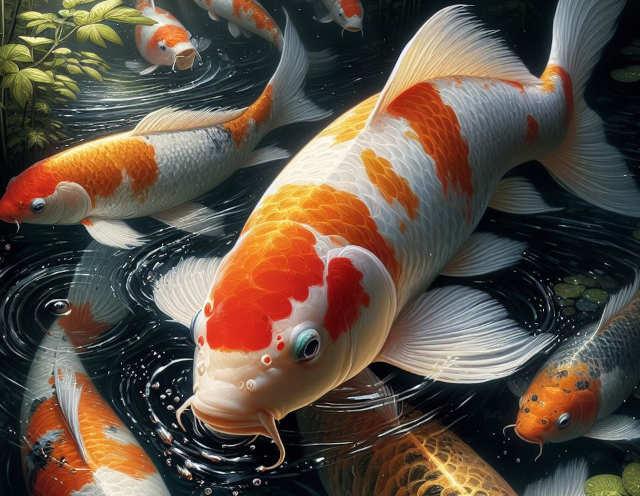
The story of a carp passing the Dragon Gate and becoming a dragon is one of the best-known images associated with koi. It comes from Chinese folklore and has influenced wider East Asian art and cultural interpretation.
The Story of the Ascent
In familiar retellings, carp struggle upstream toward a formidable gate or waterfall. Passing it brings transformation into a dragon. Details differ among versions: the emphasis may be the journey, the difficult crossing, or the reward after persistence.
The story's force lies in the distance between an ordinary carp and an extraordinary dragon. It gives a visible form to ambition and achievement. Read it as a legend with variant tellings, rather than as one fixed eyewitness account or the historical origin of ornamental breeding.
Perseverance and Transformation
The ascent lends itself to interpretations of effort, growth, and overcoming barriers. A reader may connect it with study, a difficult project, or a personal change. That interpretation belongs to the use of the story; live koi do not undergo the literal metamorphosis described in it.
Chinese Origins and Japanese Uses
The legend should not be described as exclusively Japanese simply because Japanese ornamental koi are familiar today. In Japanese garden interpretation, a specific waterfall-and-carp motif can refer to the Dragon Gate. For example, a Japanese government feature on gardens discusses that motif in a dry-landscape setting.
A documented example is more informative than claiming that all koi ponds express Zen enlightenment. The meaning of a garden depends on its design and interpretation, not only on whether it contains carp.
Carp in Art and New Stories
Artists can emphasize motion, reflected light, pattern, or the contrast between fish and water. Writers may borrow the ascent as a metaphor or create a new adventure around a pond. A modern invented story should be identified as a retelling or fiction, rather than introduced as an ancient historical source.
Our Finnegan story offers another way to enjoy fish-inspired imagination. Its fictional character is part of the entertainment, separate from instructions for handling or keeping live animals.
Carp Streamers Are a Related Cultural Image
Japan's Children's Day streamers express hopes for children and use carp imagery in a distinct tradition. They are not evidence that each koi variety has a mandatory lucky meaning. Learn the setting of a symbol before turning it into a rule about colors, numbers, or pond design.
Enjoy the Legend Alongside Real History
Folklore and breeding history answer different questions. For ornamental development, read the history of nishikigoi. For broader interpretations, see koi symbolism and cultural contexts. The story can remain inspiring while care decisions follow the needs of actual fish.