Koi Fish Information

Main navigation

  • Getting Started
  • Koi Care
    • Koi Health
    • Short Stories
    • Humor
  • Pond Building
  • Pond Filtration
  • Water Quality
  • Koi Varieties

Breadcrumb

  1. Home

Male vs. Female Koi: How to Tell the Difference

Quick answer: Adult female koi usually have a fuller, broader body, while males are often slimmer and more streamlined. Mature males may also have thicker, more pointed pectoral fins and rough breeding tubercles during spawning season. However, no single feature is completely reliable—use several clues together, and expect young koi to be difficult or impossible to sex accurately.

Sexing koi becomes easier after sexual maturity, generally when the fish are at least two to three years old and roughly 12 inches long. Growth rate, genetics, season, nutrition, and water temperature all affect development, so age and length are only guidelines.

Male vs. female koi at a glance

FeatureFemale koiMale koi
Body shapeUsually broader through the abdomen, especially before spawningUsually slimmer and more streamlined
Pectoral finsOften rounder with a softer-looking leading edgeOften more pointed, with a thicker leading ray
VentTypically rounder and may protrude slightly when matureTypically narrower, flatter, and more slit-like
Breeding tuberclesUsually absentMay develop rough white tubercles on the gill plates and pectoral-fin rays
Spawning behaviorUsually the fish being chased and nudgedUsually chases and nudges the female

These are tendencies, not guarantees. A slim female, a heavy male, or a fish outside breeding condition can easily be misidentified.

1. Compare body shape

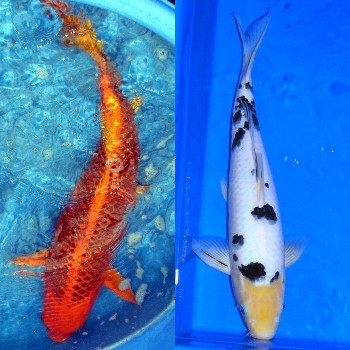
Body conformation is the easiest clue to see from above. Mature females commonly develop a deeper, wider abdomen, particularly as eggs develop before spawning. Males tend to remain narrower from the shoulders to the tail.

Male and female koi body shape comparison viewed from above

Body shape alone is not proof of sex. Overfeeding, obesity, constipation, tumors, internal disease, and retained eggs can also enlarge the abdomen. Compare koi of similar age and variety, and look for smooth, even fullness rather than one-sided swelling.

2. Examine the pectoral fins

The pectoral fins sit just behind the gill covers. Adult females often have larger, rounder pectoral fins with a softer outline. Adult males frequently have a more triangular or pointed shape and a noticeably thicker first fin ray.

Rounded pectoral fin shape often seen on female koi

Pointed pectoral fin shape often seen on male koi

Fin shape varies among individual koi, and damaged or regrown fins can be misleading. Fin color and transparency are not dependable by themselves, so combine this clue with body shape, maturity, and seasonal signs.

3. Check the vent only when necessary

The vent is located on the underside of the fish just in front of the anal fin. In a sexually mature female, it is generally rounder, softer, and sometimes slightly raised. A mature male's vent is usually flatter, narrower, and more slit-like.

This check requires lifting and turning the koi, which can injure or severely stress the fish if done incorrectly. Observe body shape, fins, and behavior first. If a vent examination is genuinely necessary, use a koi sock or proper handling bowl, wet your hands, support the entire body, minimize air exposure, and have an experienced koi keeper or aquatic veterinarian help. Never squeeze the abdomen to force eggs or milt from a koi.

4. Look for breeding tubercles

During breeding season, mature males may develop tiny, rough, white bumps called breeding tubercles on the gill covers and the leading rays of the pectoral fins. They can feel similar to fine sandpaper. These tubercles are temporary and may be difficult to see, but when present they are one of the stronger signs that a koi is male.

Do not confuse breeding tubercles with ich. Breeding tubercles are normally concentrated on the gill plates and pectoral fins of an otherwise healthy male. Ich commonly resembles scattered grains of salt on the body and fins and is often accompanied by flashing, clamped fins, or other signs of distress. Review the koi health guide if spots appear with abnormal behavior.

5. Watch spawning behavior

Spawning provides some of the clearest behavioral clues. Males typically chase and press against a ripe female, encouraging her to release eggs. The female is usually larger through the abdomen and is the focus of the pursuit.

Behavior observed outside an actual spawning event is less reliable. Koi may follow or jostle one another for food, space, or curiosity. Learn more about timing, pond preparation, and egg care in our koi spawning guide.

How to sex koi step by step

  1. Confirm that the koi is mature enough. Identification is most reliable in sexually mature fish. Juveniles often lack the visible differences needed for a confident answer.
  2. Observe from above. Compare the width of the shoulders and abdomen with other koi of similar age and size.
  3. Study the pectoral fins. Look at overall shape and the thickness of the leading ray, not color alone.
  4. Consider the season. Females may become fuller with eggs, while males may show breeding tubercles as water warms.
  5. Watch group behavior. During a genuine spawn, note which fish is being pursued and which fish are doing the chasing.
  6. Use at least two or three clues. Avoid declaring a sex based on one fin, one photograph, or body size alone.

Why young koi are difficult to sex

Male and female juveniles usually have similar body shapes and fins. Sellers and breeders may make an educated guess, but certainty is limited until sexual characteristics develop. Even experienced judges can misidentify a young koi.

If sex matters for a breeding plan or show purchase, buy from a reputable dealer who clearly states whether the identification is guaranteed or only an estimate. Otherwise, focus on health, conformation, skin quality, and pattern rather than choosing a juvenile by presumed sex. Our koi varieties guide can help with identification by variety.

Common koi-sexing mistakes

  • Assuming every large koi is female. Males can grow large, and growth depends heavily on genetics and husbandry.
  • Assuming a round belly always means eggs. Uneven swelling or a sudden change can indicate a health problem.
  • Using pectoral-fin color as the deciding factor. Color and opacity vary too much to be dependable alone.
  • Trying to sex very young koi. A confident answer may simply not be possible yet.
  • Squeezing the abdomen. This can injure the fish and should not be used as a casual identification method.
  • Confusing breeding tubercles with disease. Consider the location of the spots and the koi's overall behavior.

Frequently asked questions

At what age can you tell if a koi is male or female?

Sex becomes easier to identify at about two to three years of age, often after a koi reaches roughly 12 inches. Some fish mature earlier or later, so several physical and behavioral signs should still be used together.

Do female koi always grow larger than males?

Females often develop larger, fuller bodies, which is one reason they are common in koi shows. However, sex does not determine final size by itself. Genetics, pond space, nutrition, water quality, age, and stocking density all matter.

Can you determine koi gender from color or pattern?

No. Color and pattern identify koi varieties and influence show quality, but they do not reliably reveal sex. Body conformation, fins, vents, seasonal tubercles, and spawning behavior are more useful.

Can female koi produce eggs without a male?

Yes. A mature female can develop eggs without a male present, but the eggs cannot be fertilized without milt from a male. Some females reabsorb eggs, while others may release them when conditions trigger spawning behavior.

Should a backyard pond contain only females?

No. Male and female koi can both be excellent pond fish. Females may develop fuller bodies, but males often maintain strong color and streamlined conformation. Choose healthy koi that suit your pond rather than selecting by sex alone.

The bottom line

The most reliable way to distinguish male and female koi is to combine several signs: adult body shape, pectoral-fin structure, vent shape, breeding tubercles, and spawning behavior. Be cautious with juveniles and avoid unnecessary handling. Whether male or female, every koi benefits from stable water quality, appropriate feeding, adequate space, and consistent observation. For the complete foundation, visit our koi care guide for beginners.

Footer

  • Contact
  • FAQ
  • Privacy Policy
  • Terms